by Richard deCosta
Composer, Founder of Turing Opera Workshop and Cantai Intelligent Singing Synthesizer
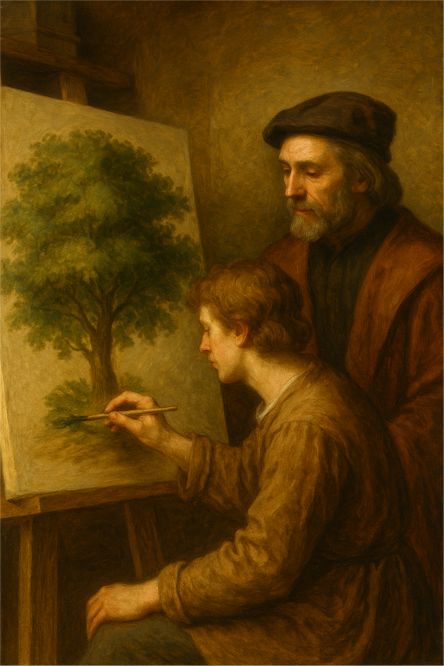
Imagine you’re standing in a Florentine workshop around 1439. A master painter turns to an apprentice and says, “Paint me a tree with just one stroke. The trunk, shadowy branches, leaves catching the afternoon sun—all of it at once.” Traditionally, artists built up scenes layer by layer, starting with dark underpainting, then mid-tones, then finally highlights. But what if it could happen instantly? That’s the core idea behind composer Richard deCosta’s concept of the MetaMacroBrush.
Our story begins with a simple observation: in art, broad strokes often carry the weight of meaning. In 17th-century Amsterdam, the great painters learned to suggest entire forests of foliage with one sweeping brush—a technique that conveyed texture, depth, and vibrancy all at once. It was a revelation: the macro could imply the micro.
Skip forward to the 1950s, when Iannis Xenakis employed mathematics as his brush. He set probability distributions, amplitude envelopes, stochastic processes—and watched as complex sonic structures emerged. It was not manual note-by-note composition, but design of a system that composed itself. The macro directive—‘density of sound’—yielded micro-level complexity: clusters of sound, evolving textures, patterns that could never have been written by hand in a single sitting.
In the 1970s, Brian Eno, famed for ambient music, took this concept even further. He treated music as generative ecology, establishing parameters—tempo ranges, harmonic palettes, textural densities—and then letting the system run. His Co-Lab with Mack and Peter Schmidt produced Oblique Strategies: cards with evocative instructions, letting chance guide creation. Eno’s MetaMacroBrush was conceptual: a prompt that became music, as if the instruction itself was the brushstroke.
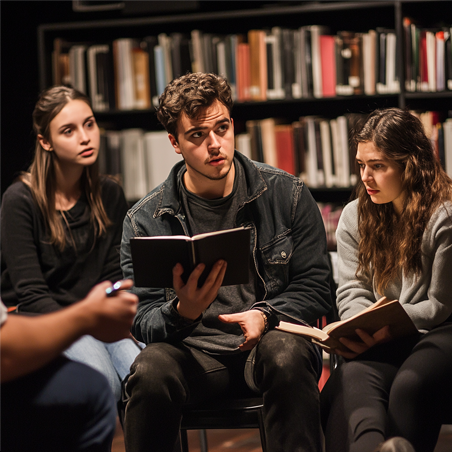
Consider the theatrical improv director who offers a single, evocative prompt: ‘a secret meeting in a library.’ This succinct macro-instruction serves as a powerful MetaMacroBrush, unleashing a torrent of micro-details from the ensemble. Instantly, actors begin to weave a narrative tapestry: characters emerge with spontaneously generated backstories and hidden agendas, dialogue crackles with subtext and nascent conflicts, and the imagined space of the library becomes populated with unspoken rules and tensions. The initial directive doesn’t prescribe specific lines or actions; instead, it provides fertile ground from which a unique, complex scene, rich with human interaction and emergent storytelling, organically blooms in real-time.
Today, AI effortlessly turns words into vivid scenes, conjuring detailed videos from simple text descriptions, transforming rough sketches into lush landscapes, and spinning a single phrase into immersive narratives. Yet we stand at a crossroads: will we view these AI-generated visuals as final works, or embrace them as first frames—dynamic openings in a broader canvas? The MetaMacroBrush concept proclaims: these creations are starting points, visual sparks ready to ignite human-guided exploration, refinement, and boundless visual storytelling.
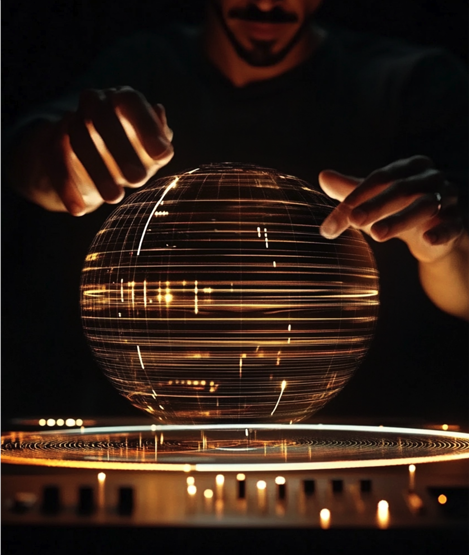
Picture a sphere floating before you in a VR studio. Your right wrist rotates, effortlessly shifting chord families—major, minor, diminished—and adjusting pitch. Move right, and the music rises into brighter keys; shift left, and it descends into deeper, darker sonorities.
At the same time, your left hand draws expressive shapes in mid-air. A spiral generates lush, swirling arpeggios, while a sharp zigzag brings crisp, staccato percussion.
Facial expressions add yet another dimension: a furrowed brow intensifies the minor mode, a gentle smile evokes brighter, uplifting harmonies. Your gaze directs spatial depth: looking upward expands reverb, making the music feel expansive; a downward glance draws the sound inward, intimate and close.
Voice commands integrate seamlessly: whisper “accelerate,” and tempo gently rises; say “hold,” and the AI sustains a lush chord, strings and woodwinds suspended in an ethereal moment.
All these elements—gesture, gaze, voice, expression—blend into one unified creative process. They’re not separate tools, but facets of a single artistic gesture. Each broad action naturally unfolds into intricate musical details: harmonies, rhythms, textures, orchestration, and mixing choices all emerge intuitively from your intent.
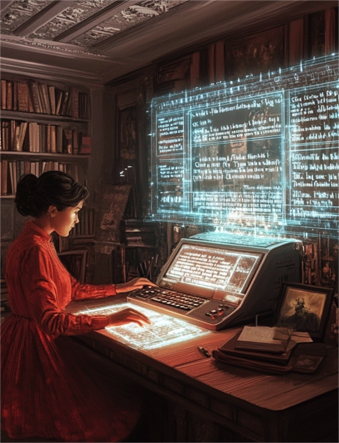
The Story Artist uses a pen-like controller where one stroke expands into multiple narrative threads, creating dialogue, backstory, character motivations. A single spoken word, like “betrayal,” instantly conjures scenes rich with tension, secret glances, charged dialogue, and dynamic virtual staging.
The Visual Artist’s MetaMacroBrush uses broad brushstrokes on a 3D canvas: a circle becomes a castle turret; a jagged line evokes stormy clouds. Under the hood, AI fills in brick textures, weather effects, architectural details. It’s like DNA unpacking from a seed—macro input yields full organism.
Our “Opera Meistre” now stands in the center, like a Dungeon Master of the operatic world. They coordinate it all—music, visuals, story—through live inputs and shifting focus. With hands raised like a conductor, gestures blend mediums into one cohesive performance. A sweep across the horizon line shifts the scene: music modulates to match, lighting changes color, virtual camera angles adjust. The entire production responds instantly to a single directive.
Why does this matter? Because art has always been about guiding complexity with personal vision. From cave paintings to cathedrals, from sonnets to symphonies, creators imbued their works with nuance through laborious detail. The MetaMacroBrush doesn’t replace that labor; it amplifies intention. It frees creators from menial tasks, allowing them to focus on essence—mood, narrative, emotional truth.
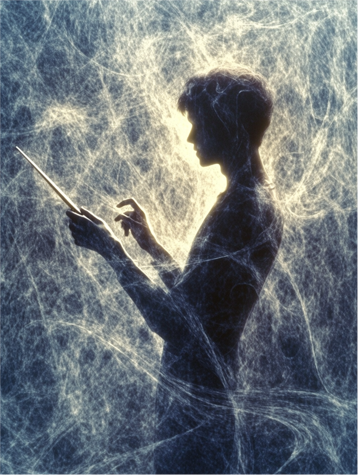
And yet, the final product isn’t just a synthesized performance. It’s a starting point: raw AI output awaiting human refinement—temporal edits, expressive tweaks, dramaturgical adjustments. The AI draft ignites our imagination, but the human hand shapes the final shape.
We’ve seen this pattern before. When photography arrived, painters didn’t vanish—they explored new styles: Impressionism, Expressionism, Abstract art. Photography liberated painting from representation, not replaced it. The MetaMacroBrush will do the same for all creative fields. It will free us to explore new aesthetic frontiers, fusing disciplines in ways we haven’t yet dreamed.
In VR/AR environments, audiences will inhabit live generative performances. Imagine attending an opera where every gesture from the stage ripples into your headset—where narrative branches choose your path, where the virtual set adapts to collective audience sentiment. Each performance a unique co-creation between artists, AI systems, and you.
This is the future—and it’s already assembling itself. Text-to-video, gesture-controlled music, gaze-directed spatial audio, real-time narrative engines, and vocal synthesis from score are no longer isolated breakthroughs. The MetaMacroBrush is the unifying principle that connects them, transforming a patchwork of tools into a coherent, fluid creative environment.
So here’s the point—our grand conclusion that feels obvious in retrospect: complexity need not be crafted note by note or pixel by pixel. It can be summoned through a single intention backed by generative intelligence. The macro stroke unlocks the infinite detail within.
That is the power of the MetaMacroBrush: a tool that honors the creator’s vision, turbocharges their workflow, and invites exploration of new creative landscapes. Whether you’re painting a forest, composing an aria, writing a play, or staging an interactive VR opera, the principle remains: guide broadly, refine intimately.
We stand at the dawn of a new creative epoch, where human imagination and machine intelligence dance in seamless partnership. The brush is in our hand—let’s paint our future.
–
Richard deCosta is a composer living and working in Saco, Maine. He is the founder of Turing Opera Workshop and the creator of cantai, an AI-powered vocal synthesizer that transforms written sheet music into lifelike operatic and choral singing.